C-PACE solar financing: How commercial owners fund large projects
Commercial property owners in 38-plus states can now fund large solar installations through C-PACE solar financing without tapping equity or restructuring existing debt. The SEIA 2025 commercial solar market outlook shows commercial solar added more than 19 GW in 2024, the largest annual figure on record. This mechanism attaches the repayment obligation to the property tax bill rather than the borrower, letting owners fund projects from $250,000 to $50 million with fixed terms up to 30 years and no upfront capital required.
What is C-PACE solar financing and how does it work
C-PACE solar financing (Commercial Property Assessed Clean Energy) allows commercial property owners to fund solar installations by borrowing against the assessed value of their property, with repayment collected through the property tax system. A state must first pass enabling legislation; a local program administrator then approves the project, records a special assessment lien, and disburses proceeds to the solar installer. The property owner repays through a line on the property tax bill, typically semi-annually, over 10 to 30 years.
Because the assessment attaches to the property rather than the borrower, a change in ownership does not accelerate the obligation in most programs. The incoming buyer either assumes the remaining balance or the seller pays it off at closing. This structural feature makes C-PACE compatible with stabilized commercial real estate such as hotels, warehouses, office buildings, and retail centers where ownership may turn over during the repayment window.
The lien sits behind property taxes but ahead of first-position mortgages in most states, which is why lender consent is required in all major programs. NREL solar research has documented growing lender participation in PACE markets since the first large transactions closed in California and Colorado in 2012.
We cover the details separately in Residential solar financing alternatives 2026: the post-distress map.
Eligible properties and project types under C-PACE
Most state C-PACE programs cover commercial, industrial, agricultural, nonprofit, and multifamily properties with five or more units. Single-family residential properties are excluded in nearly all jurisdictions. Those owners access a separate structure called R-PACE, which the Consumer Financial Protection Bureau regulates under its mortgage servicing rules. Eligible improvements typically include rooftop solar, ground-mount arrays, battery storage paired with solar, EV charging infrastructure, and energy efficiency retrofits.
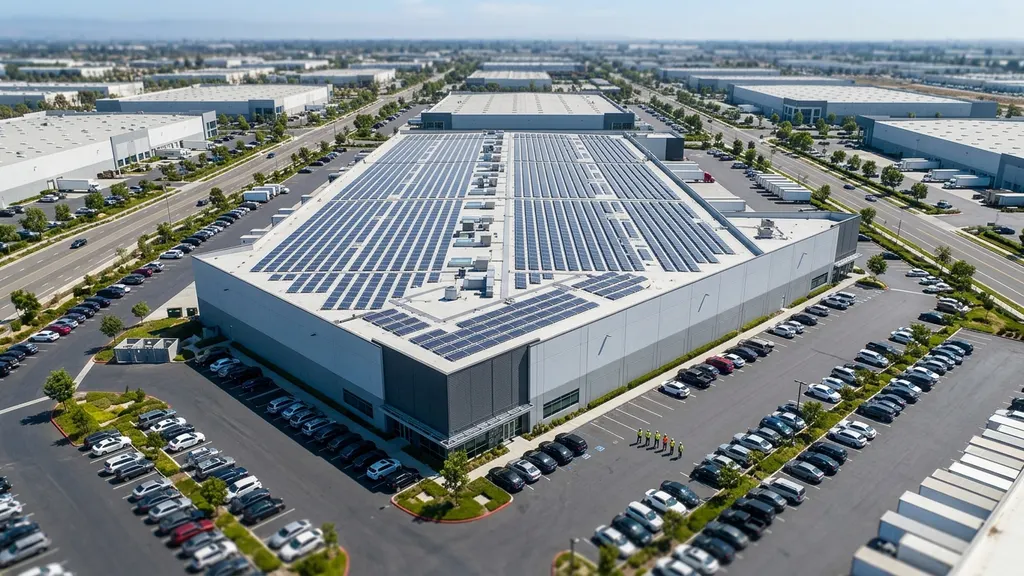
For solar specifically, eligible projects include rooftop systems from 50 kW to multi-megawatt scale, carport canopies with bifacial modules, and ground-mount systems on industrial parcels. Battery storage qualifies as a stand-alone improvement in roughly 20 states and as a paired improvement in most others. Maximum assessment limits run 20 to 25% of the property appraised value, creating practical project size ceilings that vary by asset class and local program rules.
How C-PACE solar financing compares to traditional commercial loans
C-PACE solar financing differs from conventional commercial real estate debt in four ways: lien position, term length, recourse structure, and draw mechanics. A traditional commercial solar loan runs 5 to 10 years, requires the borrower to personally guarantee the obligation, and sits in second or third lien position when other debt is present. This mechanism runs 10 to 30 years, is non-recourse to the borrower, and attaches as a super-priority assessment ahead of existing mortgage debt.
| Factor | C-PACE Solar Financing | SBA 504 Energy Loan | Conventional Bank Loan |
|---|---|---|---|
| Maximum term | 30 years | 20 years | 10 years |
| Personal guaranty | None required | Required | Required |
| Project cost coverage | Up to 100% | Up to 90% | 70-80% |
| Lien position | Super-senior assessment | Second lien | First or second lien |
| Transfers at sale | Yes, to new owner | No, accelerates | No, accelerates |
| Lender consent required | Yes | No | No |
| Typical approval time | 30-60 days | 60-90 days | 90-120 days |
From a cash flow standpoint, the extended term often allows the annual assessment payment to fall below the avoided electricity cost, producing positive cash flow from day one on buildings with strong solar resources. NREL solar resource data shows commercial rooftops across most of the Sunbelt generate 1,300 to 1,800 kWh per installed kW annually, making the economics attractive for warehouses, big-box retail, and hotels with large flat roof areas.
The underwriting process for C-PACE solar financing
C-PACE solar financing underwriting centers on the property rather than the borrower's creditworthiness. The program administrator reviews three inputs: a current property appraisal or tax-assessed value, an energy production model showing expected annual kWh generation, and lender consent from any mortgage holder of record. The energy model must demonstrate that projected annual savings meet or exceed the annual assessment payment in most programs.
Approval timelines run 30 to 60 days from a complete application in programs with standardized documentation. That is materially faster than the 90-to-120-day cycle common for SBA 504 commercial energy loans. Lender consent is the most frequent source of delay: CMBS and conduit lenders may require a servicer review before granting consent, adding 30 to 45 days. Programs that maintain pre-negotiated lender consent templates shorten that step to days in established markets like California and Colorado.
For installers handling both residential solar and commercial accounts, this underwriting approach differs sharply from the homeowner-facing process. Our utility-data solar pricing guide covers how residential proposals are built from interval usage data and utility rate schedules. On the commercial side, the property asset drives the approval decision, and a third-party production model replaces the bill-based savings estimate.
State programs: where C-PACE is available and growing
Enabling legislation determines availability. The DSIRE incentive database lists active C-PACE programs in California, Colorado, Texas, Florida, New York, Connecticut, Ohio, Illinois, and more than 30 additional states plus the District of Columbia. California and Colorado are among the highest-volume by funded project count; Texas and Florida are growing rapidly as the commercial solar pipeline expands.
States without enabling legislation require property owners to rely on conventional debt, which partly explains why commercial solar covers only a fraction of addressable square footage. EIA commercial buildings survey data shows fewer than 3% of eligible commercial structures carried an active solar system as of the most recent survey year. C-PACE is one structural mechanism working to close that gap in states where enabling law exists.
For capital partners evaluating geographic concentration, the C-PACE assessment lien survives borrower bankruptcy in most states, a durability feature that institutional lenders and rating agencies factor into credit analysis. Our review of residential solar ABS rating methodology from KBRA, DBRS, and Moody's covers the adjacent lien-based securitization framework. Capital partners can also reference our TPO residential solar IRR underwriting framework for how recurring payment structures are modeled across long-tenor solar assets.
C-PACE solar financing and federal tax incentives
C-PACE solar financing can be paired with the 30% Investment Tax Credit (ITC) available under the Inflation Reduction Act. The ITC applies to the full installed cost of a solar system regardless of the financing source, so a $2 million commercial rooftop funded through C-PACE still generates $600,000 in federal tax credits. Property owners with sufficient tax appetite claim the credit directly; those without can transfer or sell it under IRA direct-pay and transferability rules in force since January 2023.
The 48E tech-neutral ITC replaces the legacy 48(a) credit for projects commencing construction after 2024. Our coverage of the 48E TPO solar tax credit and the OBBBA pathway provides the full phase-down schedule. For commercial C-PACE projects, the key coordination point is documenting the construction start date before C-PACE proceeds close, as most programs disburse at permit-ready stage and IRS safe-harbor rules require physical work or 5% cost incurrence by a set date.
SEIA industry research shows that tax credit transfer markets have priced prime commercial solar ITC at 90 to 94 cents on the dollar since 2024, making monetization practical for asset owners who cannot directly absorb the credit. Pairing this structure with a tax credit transfer generates a blended cost of capital that often outperforms conventional financing on a net present value basis.
Frequently asked questions
What is C-PACE solar financing and who qualifies?
C-PACE solar financing is a state-authorized mechanism that lets commercial property owners fund solar installations through a special assessment added to the property tax bill. Qualifying properties include commercial, industrial, agricultural, nonprofit, and multifamily buildings with five or more units. The DSIRE database tracks active programs in 38-plus states. Single-family homes are excluded from C-PACE in most jurisdictions. Eligibility depends on the property's assessed value, existing lien structure, and whether the current mortgage lender will grant consent for the super-senior assessment lien that C-PACE creates.
How does C-PACE compare to a conventional commercial solar loan?
A conventional commercial solar loan runs 5 to 10 years, requires personal or corporate guaranty, and is structured as recourse secured debt. C-PACE runs 10 to 30 years, is non-recourse to the borrower, and repayment attaches to the property tax assessment rather than the entity. The extended term typically drops the annual payment below the annual electricity savings, producing positive net cash flow from year one. The trade-off is a super-senior lien position that requires lender consent before the assessment closes, adding 30 to 60 days to the closing timeline.
Does the C-PACE obligation transfer when a property sells?
Yes, in most state programs. The remaining assessment balance transfers to the new property owner at sale rather than accelerating as a payoff obligation on the seller. The seller discloses the outstanding balance as part of the property conveyance, and the buyer continues paying through the property tax system. Some purchase agreements negotiate a partial payoff as a sale condition, but the non-acceleration feature is a core structural element of C-PACE, distinguishing it from conventional commercial loans and from R-PACE residential products reviewed in the CFPB PACE Loan Market study.
What types of commercial properties are best suited for C-PACE solar financing?
Properties with large flat or low-slope roofs and high electricity consumption are the strongest candidates: warehouses, distribution centers, big-box retail, hotels, and cold-storage facilities. EIA commercial building energy consumption survey data shows these asset types account for the largest share of commercial electricity spend. Ground-lease and net-lease structures require additional legal review to confirm the assessment attaches to the fee interest. Multifamily assets with five or more units qualify in most states, making garden-style apartment complexes and mixed-use buildings strong candidates as well.
How long does C-PACE approval take versus bank financing?
C-PACE approval typically runs 30 to 60 days from complete application to funding disbursement in programs with standardized documentation. Traditional bank or SBA 504 commercial energy loans often require 90 to 120 days and full personal financial disclosure. The main variable is lender consent: CMBS and conduit-loan lenders can add 30 to 45 days when they require a servicer review. Experienced C-PACE administrators maintain pre-negotiated consent templates with major lenders, reducing that step to a matter of days in established program states like California and Colorado.
Can C-PACE be combined with federal solar tax credits?
Yes. The 30% Investment Tax Credit under the Inflation Reduction Act applies to the full installed cost of a solar system regardless of the financing source. A commercial property owner who uses C-PACE solar financing to fund a $3 million installation can still claim or transfer a $900,000 ITC. SEIA research documents how the IRA direct-pay and transferability provisions, active since 2023, let commercial owners without sufficient tax appetite sell the credit through third-party transfer markets, typically at 90 to 94 cents on the dollar as of 2025.