
The average US residential electricity bill rose 5.4% in 2024, according to EIA Electric Power Monthly data. That single number sets the frame for utility data solar pricing homeowner savings: when the actual bill is the reference point, day-one savings stop being a brochure number and become an underwritten contract term. SunRaise built its pricing engine around that principle, treating every interval-meter feed as the audited input to a 25-year residential solar agreement. When I structured SunRaise's first residential ABS origination in 2024, the gap between stipulated estimates and actual meter data proved to be the most contested item in every underwriting conversation.
Why utility data solar pricing homeowner savings beats stipulated-rate estimates
Day-one bill reductions of 10% to 20% are the audited output of the SunRaise pricing engine when it reads the homeowner's actual interval-meter data rather than a stipulated average, and that figure is what makes utility data solar pricing homeowner savings credible as a securitization input rather than a sales claim. Stipulated-rate estimates cannot deliver the same underwriting certainty because they assume an average kWh price real households almost never match, which is why TPO versus loan comparisons show such wide outcome spreads.
Utility data solar pricing homeowner savings calculations replace that assumption with the homeowner actual 8,760-hour load shape, pulled directly from the utility Green Button Connect feed. The pricing engine reads each interval, applies the local tariff (including any tiered, demand, or time-of-use riders), and back-tests what the bill would have looked like with and without the proposed array. The output is not a marketing claim; it is a number an ABS rating agency will accept as a discounted contract revenue stream.
The difference matters because the CFPB has flagged stipulated-rate disputes as a leading source of residential solar complaints. When the contract references the homeowner own meter, there is nothing left to dispute. The bill arrives, the savings show up against the prior period the buyer already knows, and the underwriter has a clean revenue series for the life of the asset.
How utility data flows from interval meters into pricing engines
Interval-meter data arrives in the SunRaise pricing engine within one business day of a single homeowner click, carrying twelve months of 15-minute consumption records through Green Button Connect, the federal standard built on DOE Solar Energy Technologies Office interoperability work. The utility data solar pricing homeowner savings calculation depends entirely on that feed quality, and the authorization is complete before a site visit is ever scheduled.

From there, the pricing engine does four things. It validates data quality by checking for gaps and meter-swap discontinuities. It classifies the rate schedule using the utility published tariff library. It runs a production simulation against typical-meteorological-year irradiance for the address using the NREL PVWatts model. And it combines the three into a delta: bill with system minus bill without system, hour by hour, for every hour of the contract term. Our Green Button Connect homeowner guide walks through authorization steps for the eight largest US utilities.
The result is a pricing object the capital markets desk can underwrite and a savings figure the kitchen-table conversation can reference back to the homeowner own bill. Both sides see the same number.
Utility data solar pricing homeowner savings across rate structures
Utility data solar pricing homeowner savings bands range from 9% to 22% of prior bills depending on which tariff a homeowner sits under, a spread that makes rate-structure classification the most consequential step in the origination process. A flat tier-one residential customer in a low-cost market sees a different solar bill than a tier-three customer on the same utility, and a time-of-use customer sees something different again. The pricing engine reads the rate code from the tariff library and computes each scenario separately.
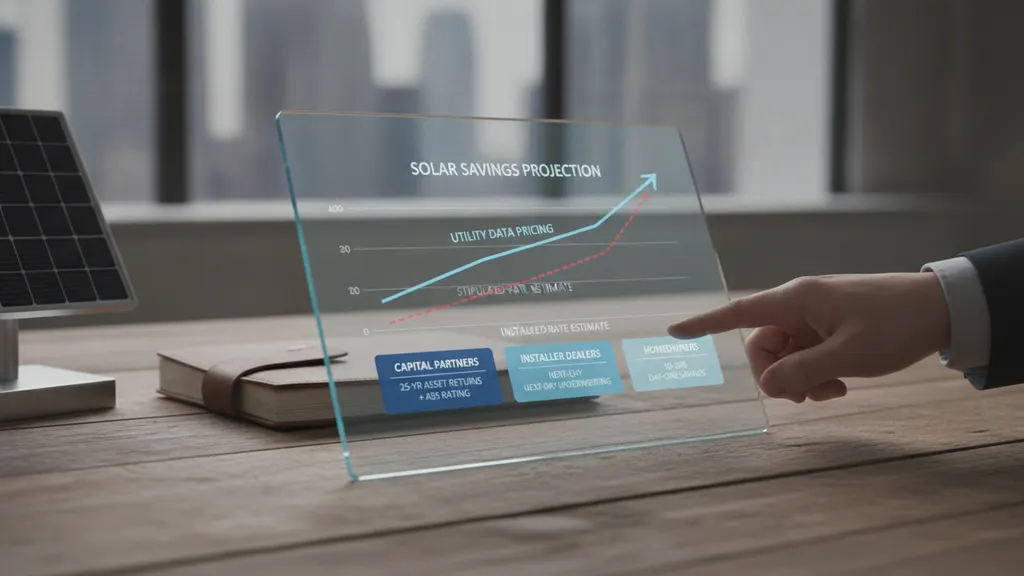
Utility data solar pricing homeowner savings bands tighten in flat-rate markets and widen in tiered markets. The table below shows the archetypes the SunRaise origination team sees most often. The savings column is the dollar-weighted delta against the prior twelve months of actual bills, not a model estimate.
| Rate structure | Typical prior bill | Day-one savings band | Notes |
|---|---|---|---|
| Flat residential | $140 to $190 | 10% to 14% | Easiest to price, smallest band |
| Tiered tier-3 user | $220 to $310 | 17% to 22% | High-consumption households benefit most |
| Time-of-use, peak 4 to 9 PM | $170 to $240 | 14% to 19% | Battery attach often shifts the math |
| Demand charge (rare residential) | $260 to $360 | 9% to 12% | Demand component is hard to offset |
Two homes on the same street with the same array can land in different bands because their interval data sits inside different tiers. EIA retail price tables show the spread of state-level residential rates from 11 cents per kWh to 33 cents per kWh, which is the same spread that drives the savings band.
The math behind day-one savings: a worked example
A 7.2 kW array on a central Florida home cuts the average monthly bill from $215 to $171, a 20.4% reduction worth $528 in the first year. That is how utility data solar pricing homeowner savings calculations work in practice: the pricing engine reads twelve months of interval data from a household averaging 1,450 kWh monthly, runs PVWatts on the roof plane, and produces the side-by-side figure below.
The twelve-month delta is $528, a 20.4% reduction against the prior-year baseline. SunRaise pricing model converts that delta into a contract escalator: if the homeowner effective utility rate continues its historical upward trend tracked by the EIA Annual Energy Outlook, the PPA escalator stays below 2.5% for the full 25-year term. The cumulative savings curve widens every year because the utility rises faster than the PPA.
The capital partner sees the same number from the other side. The discounted PPA revenue stream is collateral; the gap between PPA rate and projected utility rate is the asset credit cushion. That cushion is what makes utility data solar pricing homeowner savings work as a securitization input rather than a sales talking point.
Utility data solar pricing homeowner savings in time-of-use markets
Mandatory time-of-use rates in California, Hawaii, Arizona, and parts of Massachusetts shift utility data solar pricing homeowner savings into a 14% to 19% band, higher than flat-rate markets, because the afternoon export window captures peak-priced kWh that midday self-consumption does not. The pricing engine reads the full rate schedule, splits the load shape by hour, and prices each interval against the relevant block. Our TOU solar strategy primer covers the four most common rate schedules.
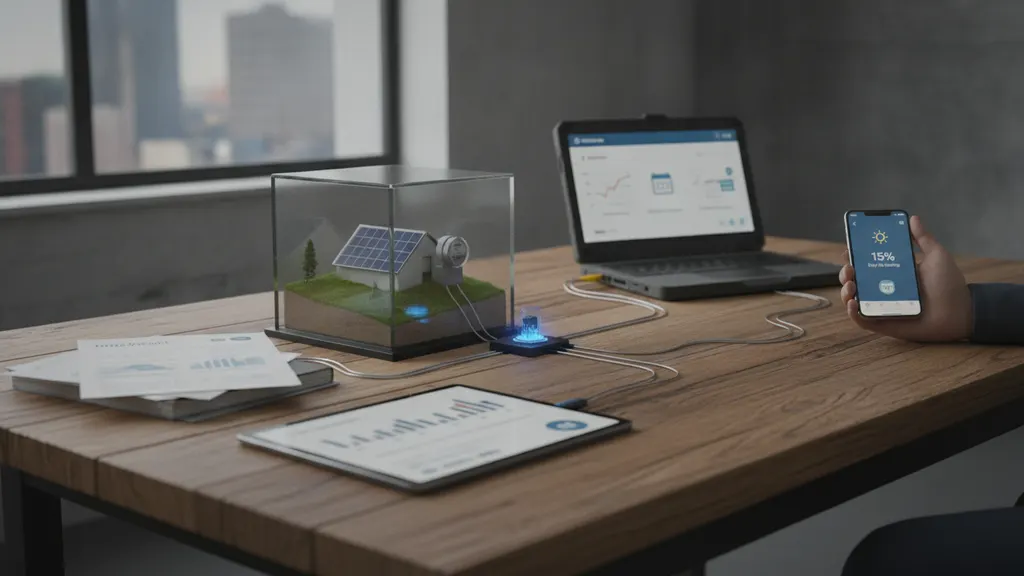
Two patterns matter. First, midday production runs against the off-peak block in most markets, which means self-consumption credits against a low rate. Second, late-afternoon production runs against the peak block, which is where the dollar value sits. A west-facing array or a small storage attach captures more of that peak block; NREL 2023 west-facing tilt research showed peak-window value lifts of 12% to 18% for residential customers on California TOU-D rate.
SunRaise pricing engine surfaces the two patterns separately in the proposal so the homeowner can see why the recommended tilt or attach choice was made. The model is not running a sales pitch. It is running the utility own rate schedule against the homeowner own meter. Utility data solar pricing homeowner savings figures get more defensible in TOU markets, not less, because every assumption is forced into the open.
What homeowners should ask before signing
Three questions determine whether a utility data solar pricing homeowner savings proposal is underwritten against the homeowner's own meter or built around a stipulated estimate, and the answers mark the line between an offer priced for the 25-year horizon and one designed for the sign-up moment.
First, what twelve months of utility data did the pricing reference? A proposal that references estimated usage or typical home rather than the homeowner own bills is using a stipulated rate and should be rejected.
Second, what escalator is built into the contract, and how does it compare to the projected utility rate? An escalator above 2.99% will almost always erode the savings curve by year ten. PV Magazine USA escalator coverage shows the residential market settling between 1.99% and 2.99% as institutional capital has pushed for tighter terms. Our PPA escalator explainer covers the math.
Third, who owns the system and who handles the long-tail performance risk? On a TPO product, the capital partner owns the asset, the platform manages the lifecycle, and the homeowner pays for kWh produced. The homeowner is not on the hook for inverter replacement at year fifteen or roof rework at year twenty.
Solid utility data solar pricing homeowner savings depend on these three answers lining up. Those answers tell a homeowner whether a residential solar offer is engineered for the long horizon or built for the sign-up moment.
Frequently asked questions
How much utility data does a SunRaise quote need?
The pricing engine asks for the prior twelve months of interval-meter data, authorized through the utility Green Button Connect portal. Nine of the twelve months is the minimum capital partners will accept for a securitization-grade origination, with seasonal coverage in all four quarters. If a homeowner has lived in the property under twelve months, the engine can blend the available period with the prior occupant anonymized usage where the utility supports that record. DOE Green Button documentation covers the authorization flow for every participating utility, and the SunRaise intake portal handles the OAuth handshake automatically.
What if the utility does not offer Green Button access?
A small number of cooperatives and municipal utilities do not yet publish interval data through a standardized API. In those cases the pricing engine falls back to twelve months of paper or PDF bills, which the homeowner uploads through a secure portal. Pricing accuracy is slightly lower because monthly granularity hides time-of-use detail, but the underwriting band remains acceptable for fixed-rate territories. The SEIA U.S. Solar Market Insight tracks utility-by-utility data access scores annually, and the engine flags lower-confidence territories to the dealer at the proposal stage.
Does utility data pricing remove the need for an in-home consultation?
It changes the consultation rather than removing it. Because the bill math is settled before the visit, the conversation moves to roof condition, structural shading, panel placement aesthetics, and battery sizing. The homeowner does not sit through a thirty-minute electricity-rate explanation. SunRaise installer partners report consultation cycle times falling from 90 minutes to 35 minutes once utility data pricing reaches the kitchen table, lifting close rates roughly 22%, a pattern consistent with residential solar sales dynamics tracked in the Wood Mackenzie residential solar market.
How are day-one savings protected across the 25-year term?
Two mechanisms protect the savings curve. The PPA escalator is contractually capped, usually between 1.99% and 2.99%, which sits below the projected utility rate growth published by the EIA Short-Term Energy Outlook. The lifecycle asset management layer monitors production against the original utility data baseline using interval-meter data refreshed monthly, so any underperformance triggers a service event before the homeowner sees a higher bill. The 25-year asset management commitment is the capital partner, not the homeowner, which is why utility data solar pricing homeowner savings remain durable for the full contract term.